02.11.2026 21:50






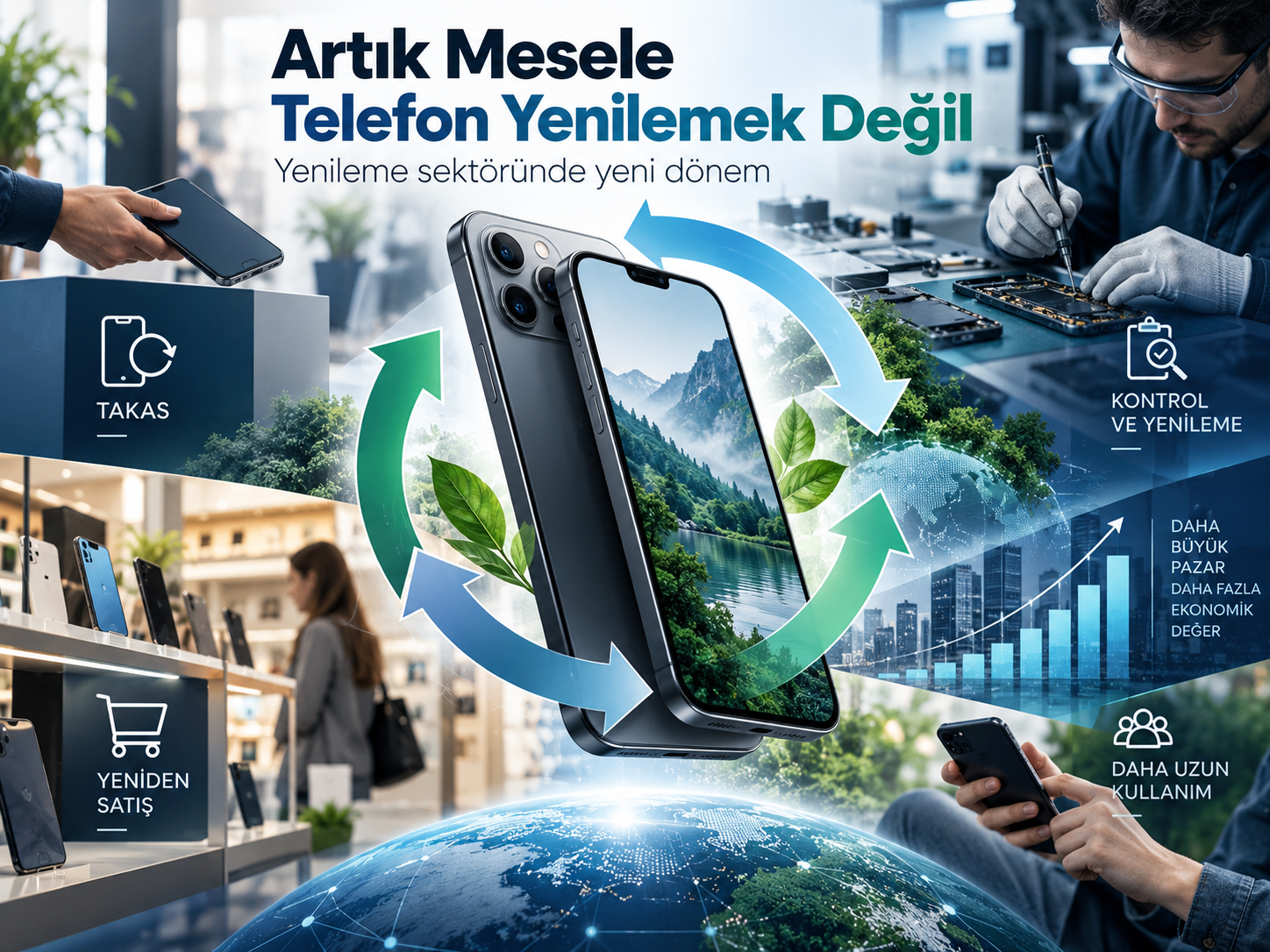
Ömer Lütfi Soylu | October 2026
On August 23, 2022, I published an article on LinkedIn titled “The Refurbishment Industry Is on the Rise: Global Economic Developments Are Increasing Interest in the Refurbishment Sector.”
I began the article by reflecting on my childhood and the relationship we used to have with our belongings. In the past, when an item broke, we would not immediately buy a new one. Instead, we would have it repaired and continue using it. When we no longer needed it, we would hope that someone else could benefit from it. Over time, this mindset was gradually replaced by an increasingly rapid culture of consumption.
In 2022, I predicted that the economic uncertainties created by the pandemic, supply chain disruptions, the chip crisis, and the Russia-Ukraine war would once again reshape our consumption habits. I also believed that the refurbishment industry would become one of the key players in this transformation.
My interest in the subject was not purely theoretical. Through Mobilfon, where I serve as Co-Founder and Chairman of the Board, I had the opportunity to be part of this transformation during the early stages of Türkiye’s refurbishment industry.
Four years have passed. Looking back today, I can see that many of my expectations regarding the industry's development have largely materialized. However, the industry is evolving into a structure that is more complex and somewhat different from what I had anticipated.
The real question is no longer simply about refurbishing a technological product. It is about who will manage a technology product’s economic lifecycle, and how.
The refurbishment industry is growing, although not at the same pace in every market. According to Counterpoint Research, global refurbished smartphone sales grew by 5% in 2024. In the first half of 2025, however, growth slowed to 3%. An even more interesting development was that sales of second-hand smartphones resold in their existing condition, without undergoing refurbishment, grew by 10% during the same period.
These figures point to an important reality: increasing consumer interest in pre-owned products does not necessarily mean that professional refurbishment centers will grow at the same rate.
This is because the refurbishment industry is no longer competing solely with brand-new smartphones. Traditional second-hand dealers, digital marketplaces, device manufacturers, mobile operators, and major retail chains are all competing for the same economic value.
Market growth and profitable growth for companies operating in that market are two different things.
Türkiye’s refurbishment industry has made significant progress since 2022. According to an announcement by the Ministry of Trade in June 2026, approximately 1.6 million products have been refurbished and brought back into the economy. The Ministry's list dated October 1, 2026, includes 29 authorized refurbishment centers.
EasyCep, Getmobil, Mobilfon, and other authorized refurbishment centers are among the key players driving this development. However, when we examine their business models, we see different strategic approaches. Some companies specialize in technical services, while others focus on reaching consumers directly, expanding their dealer networks, or integrating their operations with major retailers and mobile operators.
Updated regulations will also shape the industry's future. Higher capital requirements for refurbishment centers, improved traceability through the Refurbished Products Information System (YÜBİS), and regulations concerning consumer rights all indicate that the industry is moving toward a more institutionalized structure.
While these developments strengthen consumer confidence, they also increase companies' capital and operational requirements. Therefore, I believe that in the coming period, the companies that will gain an advantage will not necessarily be those refurbishing the highest number of devices, but those managing their capital, operations, and customer relationships more efficiently.
There is another important shift we need to consider when evaluating the future of Türkiye’s refurbishment industry.
Smartphone sales and trade-in processes have traditionally been areas in which mobile operators held strong positions. Companies such as Turkcell, Vodafone, and Türk Telekom have leveraged their extensive dealer networks and customer relationships to run device exchange campaigns alongside their phone sales operations.
In recent years, however, we have seen the role of technology retailers in this field grow considerably. Retailers such as MediaMarkt and Teknosa are no longer simply stores selling smartphones. They are evolving into businesses that buy back old devices, offer trade-in value toward new purchases, sell refurbished devices, and manage all these processes by integrating physical stores with digital channels.
According to figures announced by MediaMarkt Türkiye in April 2026, the company has purchased 250,000 old devices to date and brought 52,500 refurbished devices to consumers. The company also announced that refurbished smartphone sales had doubled year over year during the two-month comparison period. As of September 2026, its home pickup trade-in service had been expanded to 10 additional provinces outside Istanbul.
Mobilfon's role as one of the business partners in MediaMarkt's refurbished device sales ecosystem is a concrete example of the growing relationship between refurbishment centers and technology retailers. Publicly available data does not indicate that all MediaMarkt trade-in operations are carried out by Mobilfon. Therefore, it is more accurate to assess the scope of this partnership based on the verifiable information regarding its sales channel activities.
The growing influence of technology retailers does not mean that mobile operators are losing their importance. However, it is clear that competition in device sales and trade-in processes is spreading across an increasing number of channels.
The place where a technological product reaches its new owner may also be the place where its previous owner brings it back into the economy.
Competition will not only be about who sells the refurbished phone. It will also be about who gets access to the old phone first.
To better understand developments in Türkiye, it is worth looking at Europe. Two companies, in particular, stand out to me because of their business models: Back Market and Recommerce.
France-based Back Market is an international marketplace specializing in refurbished electronic products. What makes its model interesting is that the company does not refurbish devices itself. Instead, it connects independent refurbishment companies with consumers, focusing on product quality, seller standards, customer experience, and platform reliability. As of 2026, the company states that it operates in 17 countries and works with more than 1,500 vetted sellers.
It is possible to become an important player in the refurbishment economy without actually refurbishing phones.
Another French company, Recommerce, takes an integrated approach to device buyback, valuation, refurbishment, and resale. It provides operators and retailers with the technological infrastructure they need to run device trade-in programs under their own brands. Its CircularX software platform is one example of this approach.
According to company figures announced in April 2026, Recommerce has reached annual revenues of €210 million and states that it processes more than 1.1 million devices annually. What catches my attention here is not only the scale of the business, but also the evolution of its business model: Recommerce does not simply sell refurbished phones; it also provides technology and operational services that manage the economic lifecycle of devices.
Although Back Market and Recommerce have different business models, they share a common characteristic: Neither company limits value creation to the physical refurbishment process alone.
When we think about the refurbishment of a smartphone, technical service operations are usually the first thing that comes to mind. Yet the process begins much earlier and ends much later.
It involves sourcing a used device, purchasing it, pricing it correctly, assessing its technical condition, refurbishing it, certifying it, offering it for sale, and managing warranty processes.
Each of these stages requires a distinct area of expertise and involves specific costs. Devices purchased at the wrong price or those requiring higher-than-expected refurbishment costs can reduce the profitability of refurbishment centers. When inventory costs, financing expenses, spare part prices, and sales commissions are added to the equation, we see that a technically successful refurbishment operation is not necessarily a commercially successful one.
We can simply describe the traditional refurbishment model as:
“Buy the device → Refurbish → Sell.”
However, I foresee a much more comprehensive structure in the future. Device collection, AI-powered valuation, technical inspection, refurbishment, channel allocation, and the device's subsequent return to the economy through future usage cycles will all be managed as part of an integrated process.
Figure 1. The refurbishment industry's value chain: 2022–2030 (strategic outlook).
I do not believe that technical refurbishment will lose its importance in this transformation. On the contrary, it will become a critical component of a much broader system.
However, economic value does not necessarily have to be concentrated in the company performing the technical work. Companies that gain initial access to devices, price them accurately, bring them to consumers, and manage their subsequent usage cycles will also capture a share of that value.
In 2022, I made a prediction about the future of the industry. Today, four years later, I would like to do the same once again.
It will be interesting to look back at this article in 2030 and see which of my predictions have come true. Here are my five predictions as of today:
1. Refurbishment centers will no longer remain just refurbishment centers.
Some will evolve into high-capacity technical operations hubs, while others will become companies offering integrated services covering trade-ins, pricing, sales, and technology solutions.
2. Technology retailers will assume a more central role.
Companies such as MediaMarkt and Teknosa will increasingly integrate new product sales, old device buybacks, and refurbished product sales. Mobile operators will remain important, but the balance between commercial channels may shift.
3. A smartphone's second-hand value will become part of the initial purchase decision.
When buying a new phone, consumers will consider not only its current price but also how much value it will retain two or three years later. Trade-in experiences will become more widespread.
4. Artificial intelligence will become one of the core tools of the operation.
The use of AI-powered systems will increase in cosmetic and technical condition assessments, automated pricing, quality control, and inventory management.
5. Success will no longer be measured solely by the number of devices refurbished.
Profitability per device, inventory turnover, financing efficiency, customer acquisition costs, and after-sales quality will become more decisive performance indicators.
The common thread running through these five predictions is this: I believe that in 2030, measuring the success of the refurbishment industry solely by the number of devices refurbished will no longer be sufficient.
What will really matter is how much the useful life of devices is extended, how much economic value is preserved, and how that value is distributed between consumers and industry players.
I began my 2022 article by recalling the care we used to show our belongings during childhood. Looking back today, I realize that behind this habit was a rather simple economic principle:
A product's value does not end on the day we first purchase it.
In 2022, I viewed the refurbishment industry as an important consequence of the changes in our consumption habits brought about by economic crises. In 2026, I see it as part of a much broader transformation.
We are no longer talking simply about selling more affordable phones. We are talking about extending the lifespan of manufactured devices, ensuring they reach their second and third owners, using resources more efficiently, and developing new business models capable of managing all these processes.
“Who will manage the economic value generated throughout a smartphone's lifecycle, how will they manage it, and who will capture what share of that value?”
We have now added another chapter to the discussion that began in 2022. Let us leave this article here as a time capsule. Let's open it again in 2030 and see how many of our predictions have come true, where we got things wrong, and how far the industry has progressed.
Because it is no longer just about refurbishing phones.
It is about creating value all over again.
Ömer Lütfi Soylu | A New Era in the Refurbishment Industry