




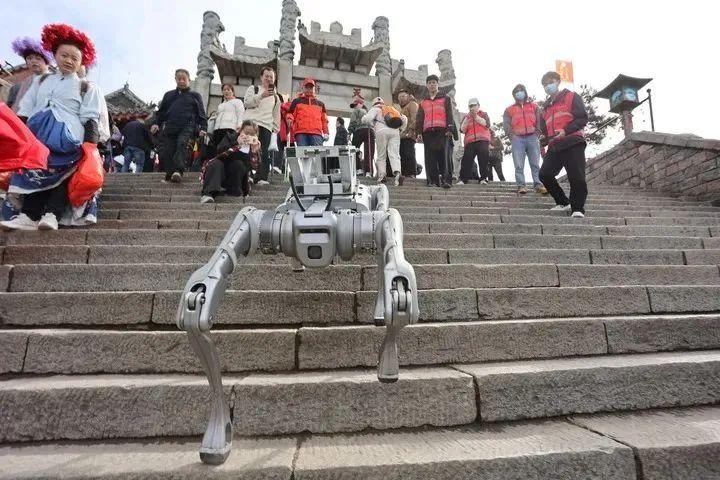
Robots tackle thousands of steps in a mountain-climbing competition in China
Automation
Hits: 5
Humanoid and quadruped robots tested their speed, balance and load-carrying ability on stepped mountain routes at a competition on Mount Tai in China.
A demanding course outside the laboratory
A robot mountain-climbing competition on Mount Tai in China’s Shandong province brought humanoid and four-legged machines into an environment very different from a smooth laboratory floor. According to the supplied report, around 90 teams took part in the event on 2 November 2026.
The longer course covered roughly 3.9 kilometres, more than 3,100 stone steps and an elevation gain of approximately 600 metres. Uneven step heights, changes in slope and tight turns required the machines to combine movement control with balance and environmental sensing.
Different courses for different robot types
A quadruped based on Unitree Robotics’ A2 platform, competing with a system developed by the Beijing Lingyi Technology team, finished the course in an official time of 43 minutes and 41 seconds. It won the speed category for four-legged robots.
Humanoid machines competed over a shorter route of about 1.5 kilometres. The Zhishen Lingyue team’s robot won that category in 27 minutes and 26 seconds. Because the routes and robot categories differed, those times should be read within their respective competitions rather than as a direct comparison between the two designs.
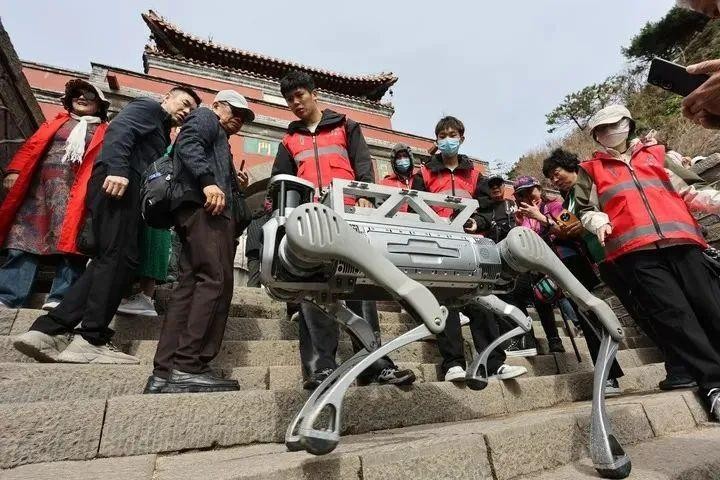
Carrying loads adds another challenge
The programme also included load-carrying tasks. Some quadrupeds climbed with items such as eggs and watermelons attached to their backs. Carrying weight changes how a robot must distribute its forces and maintain balance, making it a useful additional test beyond a simple speed run.
Such tasks are relevant to possible future work in logistics, transporting supplies over difficult ground and reaching places that are challenging for people. A successful competition run, however, is one demonstration of capability rather than evidence that all those applications are ready for routine deployment.
Falls reveal what still needs improvement
Not every robot completed its route. Some humanoids lost their balance on steep steps, and engineers had to intervene when machines fell or stopped. Those incidents showed the difficulty of maintaining reliable movement across irregular stone surfaces.
The competition offered a practical setting for teams to assess how their machines respond to changing terrain, unstable footing and the extra demands of carrying a load. The results illustrate progress in real-world mobility while also exposing the work still required to improve reliability. Search and rescue, disaster response and mountain transport remain among the possible applications motivating research into machines that can operate beyond controlled indoor environments.
Reporting: Erkan Veyseloğlu


