


The new BAYON made its world premiere in Paris, featuring an assertive SUV design, advanced connectivity features and upper-segment comfort.
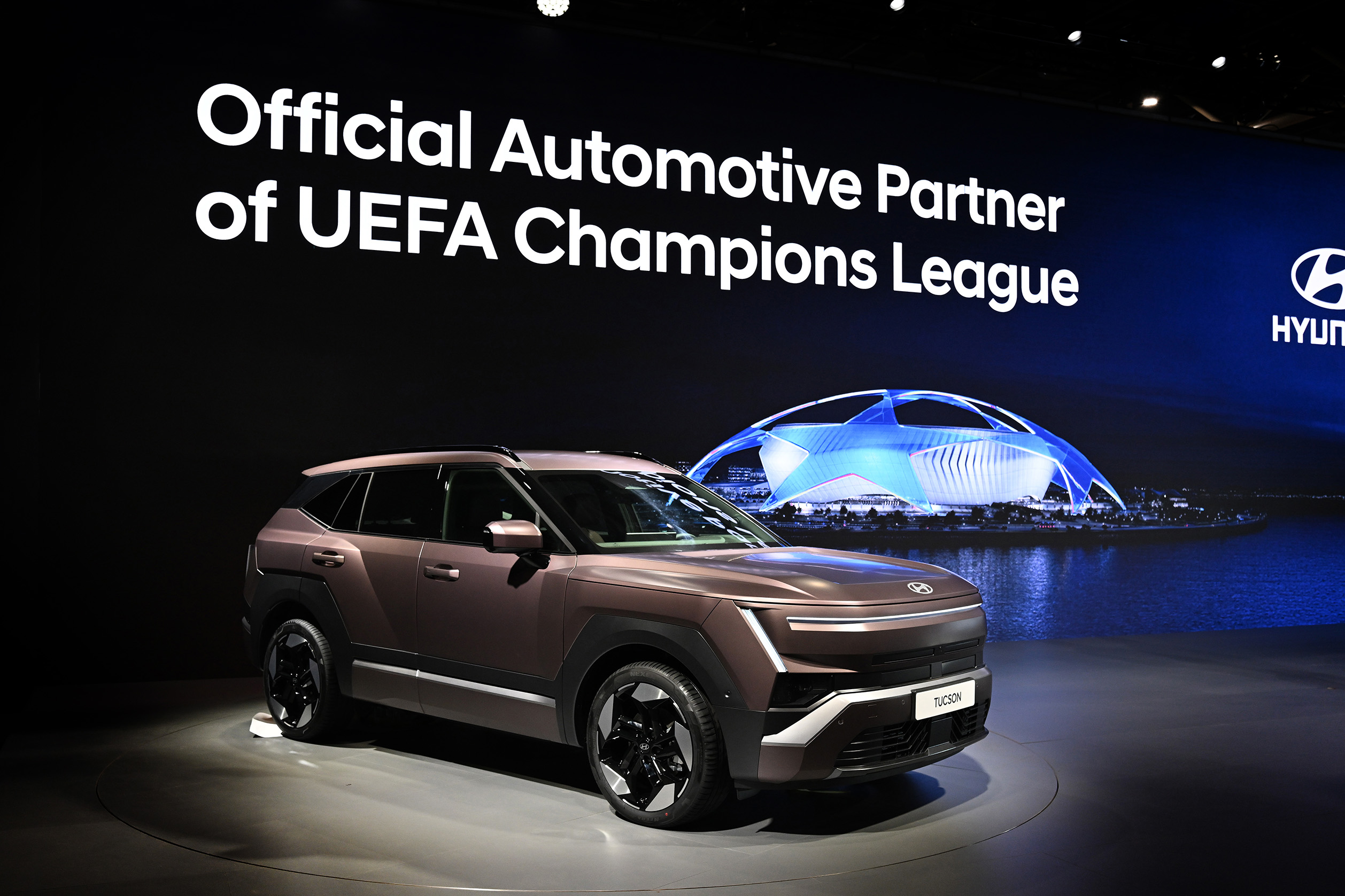
The new TUCSON presents smart hybrid powertrain options, a spacious interior and a next-generation connectivity experience with Pleos Connect at its European premiere, while the sporty TUCSON N Line makes its global debut.
With the all-electric STARIA Cargo, its UEFA Champions League partnership, collaboration with Waymo and robotics technologies, Hyundai demonstrates its growth ambitions in Europe and its vision for the future of mobility.
Hyundai unveiled three major models at the Paris Motor Show, headlined by the world premiere of the new BAYON. Alongside the global debut of its completely redesigned B-SUV, Hyundai introduced the European version of the TUCSON and the TUCSON N Line, strengthening the core of its European product range. The brand also showcased its all-electric light commercial vehicle, the STARIA Cargo.
The launch of the new SUV models, representing the next phase of Hyundai’s growth in Europe, and the company’s entry into new customer segments were supported by major strategic brand initiatives across the region. These included Hyundai’s ambition to connect with football fans and customers as the Official Automotive Partner of the UEFA Champions League, as well as the potential expansion of its partnership with Waymo into international markets. Featuring the new IONIQ 3, designed and developed in Europe for European customers and now arriving at dealerships, Hyundai’s stand reflects the brand’s strategic focus on growth in Europe and its vision for the future of mobility.
José Muñoz, President and Global CEO of Hyundai Motor Company, said: “Hyundai has been selling cars in Europe for nearly 50 years. During this time, our customers have come to trust our vehicles and our reliable service network. Today, approximately 80 percent of the vehicles we sell in Europe are manufactured here. As we continue to localize our operations, we will have invested approximately €3 billion in the region by 2030. The new BAYON and TUCSON have been designed and developed specifically for this region, with the technology and features European customers want and value.”
Xavier Martinet, President and CEO of Hyundai Motor Europe, added: “Our presence in Paris is a clear demonstration of Hyundai’s ambitions in Europe. Through major model premieres, partnerships that bring our brand closer to millions of people, and our ongoing investments in the region, we are showcasing both Hyundai’s strength today and the ambitions driving our next phase.”
New Hyundai BAYON: Authentic SUV Design, Premium Comfort and Advanced Technology
Making its world premiere at the 2026 Paris Motor Show, the new BAYON stands out as a true B-SUV that brings a bold character, advanced features and high levels of passenger comfort to everyday mobility. Reflecting Hyundai’s successful approach to combining design and technology in the compact SUV segment, the new BAYON represents the brand’s ambitions in Europe and provides a strong opportunity to reach new customers.
The new BAYON combines agility, practicality and everyday convenience with a stronger SUV identity. Its bold exterior design is complemented by intuitive technologies, advanced driver assistance systems (ADAS) and an interior that delivers enhanced comfort for all passengers.
The BAYON N Line offers a sharper, more performance-oriented character, featuring exclusive exterior and interior design elements inspired by Hyundai’s award-winning N models, including model-specific 18-inch wheels and gloss-black finishes. A rear diffuser with integrated dual exhaust outlets enhances its sporty appearance. Inside, N Line-exclusive fabric and textile suede seats emphasize its dynamic, premium character.
The BAYON’s connectivity and convenience features include Hyundai Digital Key 2, which allows users to unlock and start the vehicle with compatible smartphones and smartwatches; smartphone integration with wireless Apple CarPlay and Android Auto; and wireless charging. An optional dual 12.3-inch curved display supports a seamless connectivity experience. Heated and ventilated front seats are complemented by increased legroom, rear seats with adjustable backrest angles, a center armrest, heated rear seats and dedicated rear air vents. Together with the opening panoramic sunroof, these features bring passenger comfort typically associated with larger vehicle segments into the compact SUV class.
The longer wheelbase increases rear legroom, while the new BAYON offers class-leading headroom and shoulder room in both the front and rear. A 440-liter luggage capacity, supported by additional storage space beneath the luggage floor, further enhances practicality. The combination of passenger space, practical storage solutions, versatility and compact exterior dimensions makes the new BAYON an ideal compact SUV for daily commuting, family use and long-distance journeys.
The new BAYON will be offered with a 1.0 T-GDI engine producing 90 PS or 115 PS, with a 1.6 HEV hybrid powertrain to join the lineup at a later stage. Expected to deliver 138 PS and CO₂ emissions starting at 102 g/km, the new BAYON HEV will offer a distinctive driving experience similar to that of an electric vehicle, featuring an adaptive regenerative braking system controlled via steering-wheel paddles.
The new BAYON features a comprehensive Hyundai SmartSense package designed to assist drivers in urban traffic, on highways and during parking maneuvers. Available technologies include Highway Driving Assist 2 (HDA 2), Surround View Monitor (SVM), Blind-Spot View Monitor (BVM), Forward Collision-Avoidance Assist 2 (FCA 2), Smart Cruise Control (SCC), Lane Following Assist 2 (LFA 2), Blind-Spot Collision-Avoidance Assist (BCA), Rear Cross-Traffic Collision-Avoidance Assist (RCCA) and Parking Collision-Avoidance Assist–Reverse (PCA-R).
Xavier Martinet, President and CEO of Hyundai Motor Europe, said: “The new BAYON is much more than an update. We have strengthened its SUV character with a bolder design, more space, greater comfort and technologies that customers would normally expect from larger vehicles. In one of Europe’s most important segments, the BAYON gives us a stronger opportunity to reach new customers. With a hybrid powertrain joining the lineup in 2027, the BAYON will continue this momentum.”
European Premiere of the New TUCSON and the TUCSON N Line
In Paris, Hyundai also introduced the European version of the new TUCSON and presented the new TUCSON N Line for the first time, giving the model a more dynamic and distinctive appearance.
Bigger, bolder and smarter, the new TUCSON stands out as the best TUCSON yet. This assertive C-SUV combines advanced electrified powertrain options with Hyundai’s next-generation Pleos Connect infotainment system. Featuring the largest screen in its class at 17 inches, the system supports enhanced comfort and versatile usability.
With its increased dimensions and spacious, flexible interior, the new TUCSON has been developed to meet a broad range of customer needs, from daily commuting and family use to long-distance travel and leisure activities. The rear-door opening angle has increased from 73 to 83 degrees, making it easier to enter and exit the vehicle. The new model offers one of the most spacious interiors in its class, with 1,038 mm of front headroom, 1,002 mm of rear legroom and 1,470 mm of front shoulder room.
Since its first-generation launch in 2004, the TUCSON has become one of Hyundai’s most successful models in the region, with more than 2 million units sold across Europe. The fourth generation, introduced at the end of 2020, became the best-selling model in the C-SUV segment among private customers in Europe and retained its leadership position in 2025. This success demonstrates the trust customers place in the TUCSON.
Xavier Martinet, President and CEO of Hyundai Motor Europe, said: “Refreshing an icon is never easy. We could have taken a more cautious approach and simply refined a successful model. But that is not Hyundai’s way. We challenged ourselves to move the TUCSON forward in every area that matters to customers, from design and comfort to technology and efficiency. The result is not just the next TUCSON; it is the best TUCSON we have ever built.”
The new TUCSON embodies the philosophy of “Bold by Design” through Hyundai’s “Art of Steel” design language, combining structural strength with a commanding road presence. From its muscular exterior proportions to its refined interior, every element reflects function-driven engineering and an aesthetic vision. The exterior design is shaped around distinctive, muscular fenders that showcase the natural tension and strength of steel. This appearance is balanced by clean door surfaces and sharp body lines, reinforcing the new TUCSON’s bold SUV identity.
At the front, H-Edge lighting combines indirect central illumination with edge lighting to emphasize the vehicle’s horizontal proportions and create a wider, more balanced appearance. At the rear, sculptural Prism taillights accentuate the vehicle’s volume and contours. Their three-dimensional internal structure creates a distinctive lighting signature while reinforcing the precision and technological character of the rear design.
Depending on the trim level, the new TUCSON is also available with Micro Pixel Lighting (MPL). Using 25,600 individual LED pixels, the system provides precisely controlled light distribution as well as welcome and farewell animations. LED rear lights are standard across the entire European lineup.
The TUCSON N Line delivers a dynamic and striking appearance through its exclusive N Line exterior package. Model-specific design details sharpen its muscular character, while 20-inch alloy wheels enhance its athletic stance. The N Line design builds on the strong visual foundation of the new TUCSON.
Additional performance-inspired design elements include a more angular front bumper with a prominent lower spoiler and satin-black air channels. These are complemented by muscular side skirts, body-colored lower door cladding, gloss-black side mirrors and C-pillar details, as well as a rear bumper featuring body-colored diffuser-style extensions and dual exhaust outlets.
Sporty gloss-black details and striking N Line logos on the front section, tailgate and front fenders create a lower, sharper and more powerful appearance without changing the new TUCSON’s fundamental proportions or bold SUV identity.
The new TUCSON offers class-leading headroom, shoulder room and legroom in the front row, as well as leading headroom and legroom in the second row. Its 695-liter luggage capacity, among the best in its class, is complemented by additional comfort features such as Relaxation seats, electric steering-wheel adjustment, indirect ventilation with multiple airflow modes and Ergomotion seats. Together, these features give the TUCSON a distinctive comfort package within its segment.
The interior redefines minimalism in SUVs through its function-oriented design. The two-tier dashboard combines form and function: the horizontal upper section provides visual comfort and clarity, while the deep, open shelf in the lower section offers additional storage space.
N Line models feature an exclusive Black Monotone interior, with sporty textile suede upholstery and contrasting red accents across the seats, doors and dashboard. The N steering wheel, featuring perforated leather grips, red stitching and dark metallic details, reinforces the cabin’s sporty atmosphere. These elements give the interior a more dynamic character while preserving the spacious and practical architecture of the standard model.
The next-generation Hyundai Pleos Connect infotainment system, based on Android Automotive OS (AAOS), combines a central display available in 12.9-inch or 17-inch sizes with a slim 9.9-inch driver display, delivering a smarter and more intuitive connectivity experience. The TUCSON’s Gleo AI voice assistant enhances this experience with live data, allowing drivers to access functions and information without navigating through screen menus.
The Android Automotive OS platform also provides integrated access to compatible applications and connected services. Over-the-air (OTA) software updates allow selected vehicle systems and infotainment functions to be updated remotely. The new TUCSON is also available with a premium 12-speaker Bang & Olufsen sound system to enhance the in-car audio experience. Smart Mood Lamp interactive ambient lighting further enriches the cabin environment. Hyundai Digital Key 2 allows users to unlock and start the vehicle using compatible smartphones and smartwatches.
To reduce driver distraction, frequently used information and controls are positioned within the driver’s natural field of vision. The digital instrument display is located above the steering wheel, while the optional Head-Up Display projects essential driving information directly onto the windshield. This allows drivers to access information without taking their eyes off the road. The electrically adjustable steering wheel makes it easier to find the ideal driving position and enter or exit the vehicle.
Physical buttons beneath the central infotainment display provide direct access to essential functions. The extended center-console armrest has been designed to provide additional support when using the central display. The console includes concealed storage compartments for small personal items, along with two 15 W wireless charging units. Four 100 W USB-C ports enable fast charging for laptops, tablets and other compatible devices throughout the cabin, delivering class-leading charging convenience.
At the heart of the new TUCSON is a range of electrified powertrains, including Hyundai’s advanced next-generation hybrid system. The system has been developed to combine responsive performance with efficient, refined everyday driving.
The HEV Stay Mode available in hybrid models allows selected vehicle functions, such as climate control, the audio system and device charging, to operate for extended periods while the internal combustion engine is switched off. This creates a quieter and more comfortable cabin environment during stops and breaks.
The new TUCSON hybrid produces 245 PS and 380 Nm of torque. The plug-in hybrid TUCSON PHEV combines a 1.6-liter turbocharged gasoline engine with a 17.1 kWh battery and an electric motor, delivering 292 PS and 380 Nm of torque. Subject to final homologation, it offers an estimated all-electric range of up to 81 km with 17-inch wheels. A 7.2 kW onboard charger enables convenient AC charging at home or at public charging points. The lineup also includes a 1.6 T-GDI gasoline engine producing 150 PS, available with either a six-speed manual transmission or a 48 V mild-hybrid system paired with a seven-speed dual-clutch transmission (7DCT).
The TUCSON offers a class-leading safety package through a comprehensive range of Hyundai SmartSense driver assistance systems. Forward Collision-Avoidance Assist 2 and Highway Driving Assist 2 are complemented by technologies such as Intelligent Speed Limit Assist (ISLA) and Navigation-Based Smart Cruise Control. ISLA assists drivers in complying with detected speed limits, while Navigation-Based Smart Cruise Control uses navigation data to adjust vehicle speed according to specific road conditions.
The hybrid version of the new TUCSON offers a class-leading towing capacity of up to 1,910 kg. The plug-in hybrid version can tow up to 1,810 kg on a 12 percent gradient. Trailer Reverse Assist (TRA) is designed to simplify low-speed maneuvers by helping drivers control the steering when reversing with a trailer.
Hyundai Brings Its Electric Vehicle Expertise to the Light Commercial Vehicle Segment with the New STARIA Cargo
Alongside the next phase of its SUV offensive in Europe, Hyundai showcased the STARIA Cargo, an all-electric light commercial vehicle designed to combine advanced electric performance with practical everyday usability for businesses and professional users.
Building on its electric vehicle expertise, Hyundai is expanding its product range into the light commercial vehicle segment to meet the needs of European business customers. With a WLTP range of up to 450 km and an 800-volt electrical architecture, the STARIA Cargo delivers class-leading charging performance, charging from 10 to 80 percent in just 20 minutes. These capabilities reduce vehicle downtime and improve operational efficiency.
Its 160 kW (218 PS) electric motor delivers strong performance, while a payload capacity of 1,040 kg, a towing capacity of 2,000 kg and loading space for three Euro pallets support a wide range of professional applications. Even when carrying its maximum payload of 1,040 kg, the STARIA Cargo is technically capable of towing a trailer weighing up to 2,000 kg, providing exceptional flexibility. A comprehensive suite of Hyundai SmartSense driver assistance technologies supports safe and convenient everyday operation.
Combining Hyundai’s leadership in electric vehicle technology with car-like driving characteristics and comfort, the STARIA Cargo is designed to make the transition to electric mobility more practical for professional users while meeting the demands of everyday commercial operations.
Xavier Martinet, President and CEO of Hyundai Motor Europe, said: “Businesses should not have to choose between electrification and efficiency. That is exactly why we developed the STARIA Cargo. It combines a 450 km range and the ultra-fast charging enabled by its 800-volt architecture with the payload, towing and loading capacities professional customers need every day. The result is an all-electric light commercial vehicle developed around the needs of European users.”
Inside, the STARIA Cargo features Hyundai’s Connected Car Navigation Cockpit (ccNC), incorporating a 12.3-inch touchscreen and a digital instrument cluster for intuitive access to essential vehicle functions.
Connected features support remote vehicle management, charging-status monitoring and climate control. Vehicle-to-Load (V2L) functionality provides up to 3.5 kW of power through both an exterior outlet and an interior socket in the cargo area. This feature allows external electrical devices to be powered directly from the vehicle, increasing everyday flexibility.
Hyundai is also working with conversion partners to provide solutions tailored to the needs of local commercial customers across Europe. The company is evaluating standardized conversion solutions that could be offered through Hyundai dealerships in different European markets in the future, with the aim of providing customers with a more consistent and convenient experience.
Hyundai Becomes the Official Automotive Partner of the UEFA Champions League
Hyundai’s stand in Paris features a dedicated area highlighting its multi-year partnership as the Official Automotive Partner of the UEFA Champions League. The UEFA Champions League trophy is on display at Hyundai’s Paris Motor Show stand on Monday, October 12, the press day.
The partnership represents the company’s commitment to the highest level of European club football. Beginning with the 2026/27 season, the collaboration will continue through the end of the 2030/31 season.
Football has long been an important part of Hyundai’s identity. For nearly 30 years, the company has supported football at the highest levels, from major international tournaments to clubs and federations around the world. The UEFA Champions League partnership takes this commitment to the pinnacle of European club football.
The common ground between the UEFA Champions League and Hyundai extends beyond scale. The tournament brings together talent from every corner of the world to compete at the highest level in Europe. Hyundai, meanwhile, draws on its global reach while designing, developing and manufacturing vehicles in Europe and selling them throughout the continent.
Guided by its “Progress for Humanity” brand vision, Hyundai focuses on expanding opportunities and contributing to a more inclusive future for society. Through this collaboration with UC3, the joint venture between UEFA and European Football Clubs, the company aims to bring people from diverse cultures and communities together across Europe through UEFA Champions League engagement and Hyundai’s mobility solutions. In doing so, Hyundai seeks to connect millions of football fans while creating a positive impact on society.
Xavier Martinet, President and CEO of Hyundai Motor Europe, said: “The UEFA Champions League and Hyundai are driven by a shared ambition to advance progress, performance and the power of bringing people together. We are entering this partnership with our strongest product lineup to date. The IONIQ 3 is the first of five major new models we will introduce in Europe this season. Designed and developed for our customers in the region, the IONIQ 3 leads the way for our future lineup.”
The UEFA Champions League is the world’s most-watched annual club football competition, attracting interest from approximately one in every three people worldwide. Featuring 36 clubs, the competition provides an ideal platform for engaging a broad football audience and showcasing Hyundai’s future direction, spanning robotics and physical AI to software and smart mobility solutions tailored to European customers.
Hyundai and Waymo to Explore Expanding Their Autonomous Mobility Partnership into International Markets
Hyundai and Waymo will explore the potential to expand their strategic partnership in autonomous mobility services into international markets. The first autonomous-ready IONIQ 5 vehicles are being delivered to Waymo in the United States this year to be equipped with the Waymo Driver system. Hyundai is also showcasing this technology at its Paris Motor Show stand.
Under the Waymo partnership, Hyundai vehicles will be used in autonomous ride-hailing services in the United States. International markets are expected to become part of this journey as well.
The award-winning all-electric IONIQ 5 is built on Hyundai’s advanced 800-volt architecture, which supports ultra-fast charging. This brings world-class electric efficiency and exceptionally quiet performance to autonomous mobility.
Specifically engineered for seamless integration, the IONIQ 5 combines Hyundai’s advanced electric vehicle platform with Waymo’s sixth-generation autonomous hardware and software system. The vehicle features specially designed redundant braking and steering systems to deliver a safe, smooth and reliable ride.
Hyundai and Waymo are focused on making measurable progress toward their shared global vision, Vision Zero, which aims to eliminate traffic-related fatalities and provide equitable, stress-free mobility for everyone.
Advanced Robotics Technologies to Lead Hyundai’s Global Transformation
As part of its transformation into a physical AI and robotics company, Hyundai is showcasing its robotics innovations at the 2026 Paris Motor Show. This transformation was highlighted by José Muñoz, President and Global CEO of Hyundai Motor Company, at the CEO Investor Day 2026 held earlier this year.
Visitors to the show can explore Spot, the agile quadruped robot developed by Boston Dynamics, a Hyundai Motor Group company. They can interact with the robot and take selfies with it.
In line with Hyundai’s focus on advancing humanity by bringing people together with robots they can work alongside, Spot is being deployed at the company’s facilities worldwide for industrial inspections and predictive maintenance. By improving safety and reducing workers’ physical burdens and exposure to risk, Spot enables employees to focus on higher-value tasks.
At CES 2026, Boston Dynamics unveiled the production version of its humanoid robot Atlas, while Hyundai Motor Group announced its robotics and physical AI roadmap. Atlas will initially be deployed for sequencing tasks at Hyundai Motor Group Metaplant America by 2028, supporting the development of human-centered smart factory innovation. Advancing human-robot collaboration, Atlas will take on high-risk tasks and reduce workers’ physical burdens, laying the foundation for robot commercialization and environments in which people work alongside robots.
In Paris, Hyundai is also showcasing its X-ble Shoulder robotic technology, which operates without an external power supply. Visitors to the stand can experience this innovation firsthand.
Developed by Hyundai Motor Group Robotics LAB, the X-ble Shoulder industrial wearable robot represents a new era in wearable technology. When used for overhead tasks that require workers to raise their arms, it supports the upper-arm muscles and reduces strain on the upper musculoskeletal system.
The X-ble Shoulder improves worker safety, reduces the risk of musculoskeletal injuries, enhances user comfort and increases efficiency and productivity. The unit can reduce shoulder load by up to 60 percent and activity in the anterior and lateral deltoid muscles by up to 30 percent.
Rather than relying on an electric system, the X-ble Shoulder generates assistive force through a muscle-support module and a torque-generating structure that requires no external power supply. The absence of charging requirements simplifies maintenance and management.
Weighing approximately 1.9 kg, the X-ble Shoulder can be adjusted to suit individual users. Its body length can be adjusted between 406 mm and 446 mm, while the unit allows a full range of arm movement from 0 to 180 degrees without interfering with work or rest activities.
Hyundai’s Long-Term Commitment to Europe
Hyundai’s commitment to Europe is already delivering tangible results. Since its establishment in 2006, Hyundai Motor Manufacturing Czech (HMMC) in Nošovice has produced more than 5 million vehicles. This milestone reflects long-term stability, technological maturity and Hyundai’s commitment to manufacturing in Europe for Europe. As the facility prepares to begin production of the new TUCSON, it will further strengthen its strategic importance within Hyundai’s operations.
Like HMMC, Hyundai Motor Türkiye (HMTR) is preparing to manufacture an entirely new model and will begin production of the new BAYON later this year. Production of the new compact SUV in İzmit will also include hybrid powertrain options, supported by a new Battery System Assembly plant established at the facility earlier this year.
Significant investments have been made in both factories and in the research and development center at Hyundai Motor Europe Technical Center (HMETC) in Germany to further strengthen Hyundai’s presence in Europe. Through a €150 million investment in the new Square Campus at HMETC, Hyundai added another 25,000 m² to its R&D facilities last year, making the center one of Europe’s most advanced automotive research and development hubs.
The company invested €250 million to transform its İzmit facility, incorporating a redesigned electric vehicle underbody, high-voltage battery integration and power electronics. Production of the facility’s first electric vehicle, the IONIQ 3, successfully began in August this year.
The Nošovice factory in the Czech Republic was also expanded in 2025 to support battery production and assembly for battery-electric vehicles. As a result, total investment in the facility has exceeded €2 billion since it opened in 2008.
Hyundai Motor Europe has production capacity of approximately 580,000 vehicles across the region, with the potential to increase this capacity. The company aims to ensure that battery-electric vehicles account for more than half of its regional production.
Hyundai’s commitment to Europe is a long-term one. The company designs, develops, tests, manufactures and sells vehicles in Europe. By 2030, it will have invested more than €3 billion in the region. This approach demonstrates that, even as some companies scale back their operations, Hyundai is further strengthening its strategic commitment to Europe.
Banner Inside Article - 728x90