




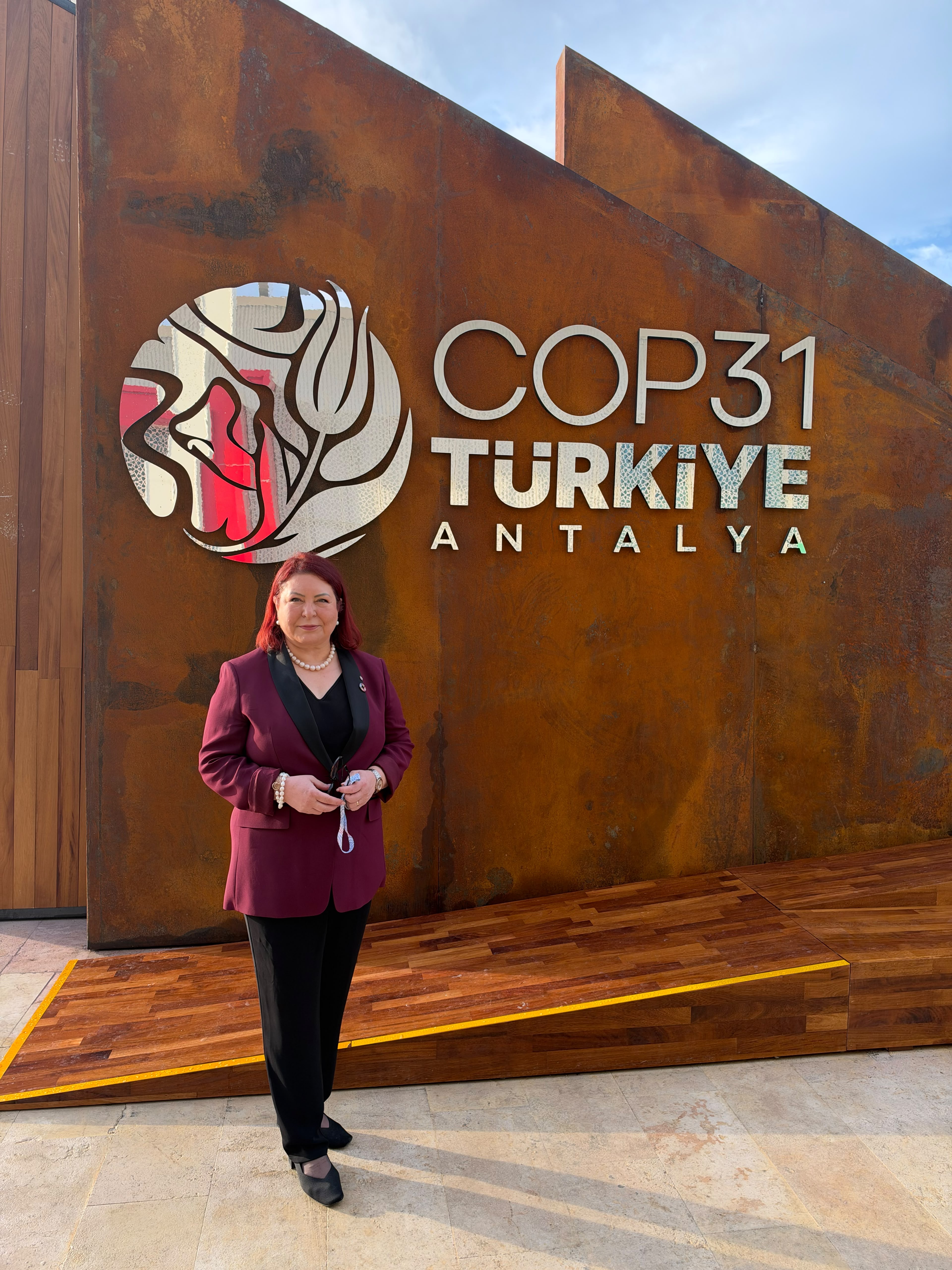
Arnica highlights green-transition finance and energy efficiency at COP31
Events
Hits: 11
Arnica Chair Senur Akın Biçer said sustainability has become a fundamental component of industrial competitiveness, speaking at the COP31 panel “Financing Green Competitiveness: Women-Led Industrial Transformation, Investment and Sustainable Value Chains.” She highlighted the importance of improving access to finance and supporting investment in domestic technology to accelerate the green transition and strengthen Turkish industry's competitiveness in global markets.
Held in Antalya on November 13, 2026, the panel examined the opportunities that the green transition presents for Turkish industry. Biçer described sustainability as a fourth component of competition alongside price, quality and delivery. In international markets in particular, she said, products’ energy consumption, resource use and environmental impact increasingly influence commercial decisions.
“We must also calculate the cost of delaying the transition”
Biçer described the green transition as an economic necessity for the future of industry: “Speaking as an industrialist, the green transition is both a financing issue and a competitive move. Which of these it becomes depends on when and how you begin the transition. Companies that postpone change face not so much change itself as the question of how much what they postpone today will cost tomorrow. Are we calculating the cost of the green transition today, or what delaying it will cost us in the future?”
She stressed the importance of financing opportunities and technological partnerships in widening investment in the transition, especially by strengthening small and medium-sized enterprises’ participation. The change needs to encompass the entire supply chain, she said. Affordable financing, technical support and incentives for domestic technology investment would contribute to sustainable growth in Turkish industry.
“Real sustainability begins at the design table, before the production line”
Arnica’s chair highlighted the decisive role of design and research and development investment. An environmentally conscious approach to manufacturing, she said, must be adopted from the product-development stage. Motor efficiency, material use and product design directly affect the environmental impact of small household appliances.
She cited Arnica’s Solara Hybrid as an example. The model received a Silver A’Design award in the international A’Design Award & Competition in 2025. According to Biçer, its 400-watt motor delivers performance close to that of 800–900-watt vacuum cleaners, doing the same work with less energy.
Solar generation supplied around one-third of the plant’s electricity
Arnica, which exports to approximately 40 countries across five continents, is also pursuing energy-efficiency measures in production. According to the company’s release, its solar power plant in the Tarsus Organized Industrial Zone supplied approximately 33 percent of the facility’s electricity consumption in 2025.
The release also reports that technological upgrades to the plastic injection machinery fleet reduced electricity and water consumption, manufacturing scrap and greenhouse-gas emissions. It does not provide percentage reductions for those individual measures.
Biçer concluded by calling for a broader understanding of industrial efficiency: “For years, in industry we defined efficiency as producing more at a lower cost. Today we need to expand that definition: creating more, and more lasting, value with fewer resources.” She said the change requires technology, financing and long-term thinking.
Understanding the figures
The comparison between 400 watts and 800–900 watts is Biçer’s statement about product performance, not an independently verified comparative test result. A motor’s power rating alone does not establish cleaning performance or total energy consumed during use. The release does not specify the comparison’s test method or operating time.
The 33 percent solar contribution refers specifically to the Tarsus facility’s electricity consumption in 2025. It does not represent the energy requirements of all company operations or a reduction in its total carbon footprint. With no reduction rates supplied for the injection machinery upgrades, the announcement does not support a numerical calculation of those savings.
About Arnica
Arnica says it has worked since 2001 to make users’ lives easier by designing and producing functional, high-quality, practical and innovative small household appliances. In its company profile, it describes itself as one of the leaders of Turkey’s small electrical household appliances sector, drawing on the experience and assurance of SENUR A.Ş., described in the release as a 63-year-old business.
The brand represents Turkey in 40 countries across five continents. It draws on SENUR A.Ş., which it describes as one of the first companies in Turkey in its field to establish a research and development department. Arnica manufactures in-house and presents its approach as “domestic production, global vision,” through which it aims to help shape the sector’s future.
Source: Arnica press release distributed November 14, 2026, datelined Antalya, November 13, 2026. Photograph: Arnica press material.
Dji Banner Inside Article - 728x90



