




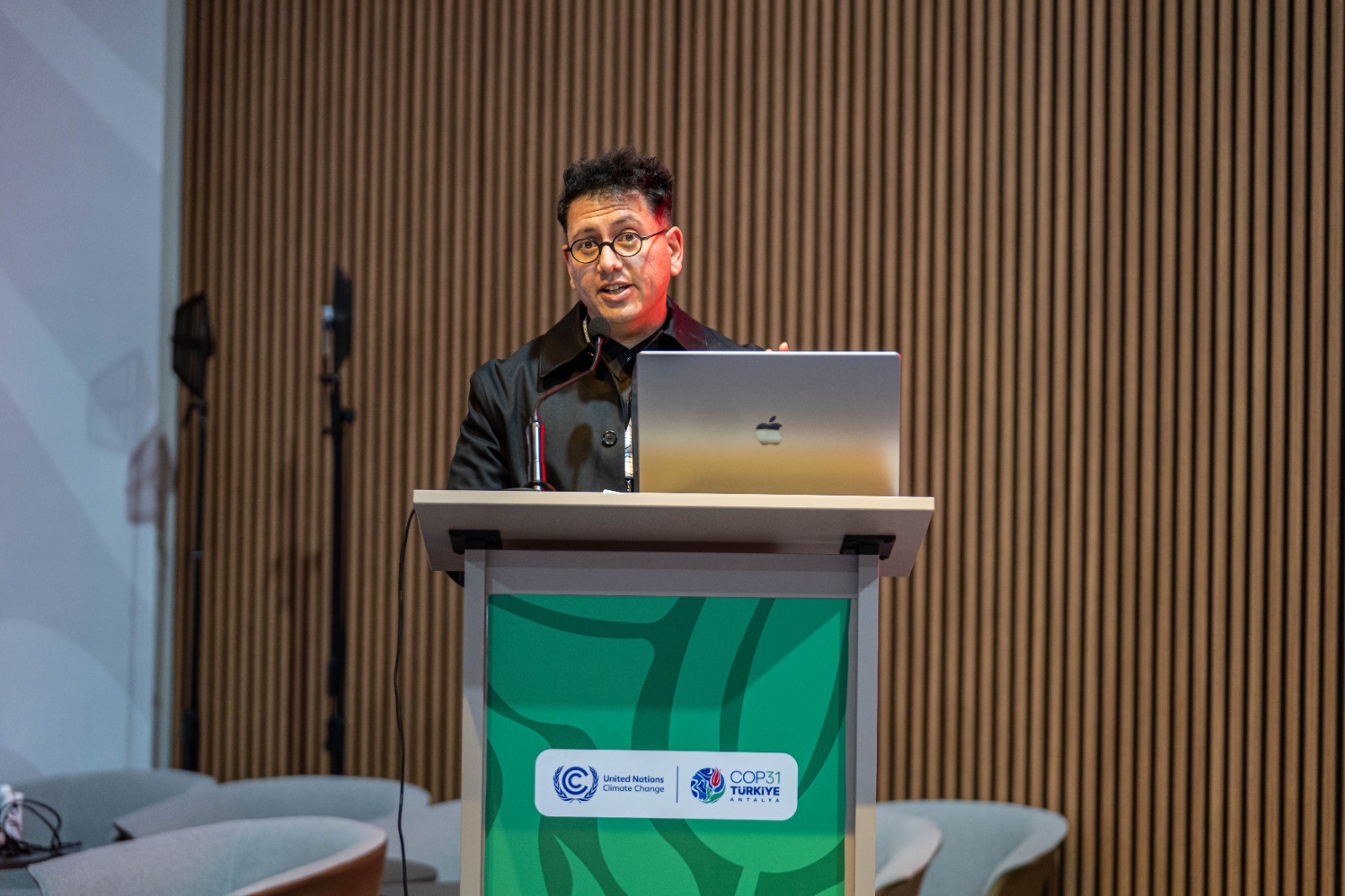
Refik Anadol presents Large Nature Model: Türkiye at COP31
AI News
Hits: 13
Digital media artist Refik Anadol presented “Large Nature Model: Türkiye,” developed in cooperation with Türkiye İş Bankası, at COP31. Built using more than 500 million data points collected from 33 national parks in Türkiye, the model aims to record the country’s natural wealth through artificial intelligence and make it available for scientific research. “We should use artificial intelligence not to imitate nature or replace it, but to understand nature,” Anadol said.
Speaking on the Climate Finance Stage on the fifth day of COP31, Anadol discussed how artificial intelligence could help people understand and protect nature through the project. He subsequently shared the story of its development during a conversation at İş Bankası’s stand in the Climate Finance Centre.
Anadol said his team had worked at the intersection of data, artificial intelligence and art for more than ten years. “For artificial intelligence, ten years corresponds to a period of almost a hundred years,” he said, stressing that the central issue was the value AI could add to humanity and nature rather than simply producing more advanced outputs.
More than 500 million data points from 33 national parks
The project, developed with Türkiye İş Bankası, involved fieldwork in 33 national parks across Türkiye. More than 150 people contributed to the research, which collected over 500 million data points. Anadol said that widely used large AI models could produce incorrect or unrepresentative results when dealing with endemic species and current nature data. He argued that a model trained on Türkiye’s own data had significant potential to address this gap.
Anadol also stressed that understanding nature’s future required more than advanced AI models. Local communities’ knowledge and humanity’s relationship with nature were integral to the process. He added that the team aimed for the model to make an international contribution.
Taking responsibility and contributing to nature conservation
Commenting on the COP31 activities, İş Bankası Deputy Chief Executive Suat Sözen said:
“The relationship between the environment and people is repeated every day, relies on habits and allows us to benefit from what nature provides. Yet we need frequent reminders that we must protect our environment. In this respect, I find COP31 meaningful. Many institutions at the summit explain their work that contributes to nature and share these contributions with the world. As an institution in the financial sector, and of course a responsible institution, we also try to demonstrate our relationship with the environment and our responsibilities in this area. We share with the public the carbon targets and commitments that are binding on us.
We have various projects aimed at improving people’s relationship with the environment. We are creating forests in every province of Türkiye. Through our 81 Forests in 81 Provinces project, we planted 2.2 million saplings between 2008 and 2017, and we aim to plant another 2.2 million between 2023 and 2031. This will bring the total to 4.4 million saplings planted. Those planted first are no longer saplings but trees, and it is truly a great source of happiness to see them grow.
As a country surrounded by seas on three sides, our seas are very precious to us and are also an important economic asset. We need to reduce human intervention as much as possible so that marine ecosystems can protect themselves. At our own scale, we carry out projects that contribute to the protection of marine ecosystems. When individuals and institutions show the necessary care within their own areas of responsibility, we can achieve much more positive outcomes for nature.”
From collection to museum
At the COPArt session “From Collection to Museum: The Story of RHM,” Prof. Dr. Gül İrepoğlu, Founding Curator of the Türkiye İş Bankası Painting and Sculpture Museum, and Museum Director Canan Atlığ discussed the transformation of İş Bankası’s collection into a museum and the curatorial approach to passing artworks on to future generations.
Protecting the future and financing transformation
At the same time, executives from Proparco, a subsidiary of the French Development Agency, and the German Investment and Development Corporation (DEG) joined the session “Financing the Future, Making Transformation Possible” at the bank’s stand. They shared perspectives on the role of development finance institutions in transformation and their vision for cooperation on projects in Türkiye.
Journalist Elif Ergu moderated “Together for Forests: Climate Crisis, Technology and Conservation.” Anadolu Sigorta’s Head of Corporate Communications, Sustainability and Disaster Management, Berna Semiz Ergüntan, and former General Directorate of Forestry executive and adviser İlhami Aydın discussed the “Eyes of the Forest” project and the steps needed to protect forests.
İş Bankası Deputy Chief Executive Ozan Gürsoy moderated “Closing the Loop: Scaling Circularity in Production.” SANKO Holding Deputy Chairman Fatih Konukoğlu and Strategy, Finance and Investment Committee member Mustafa Günbulut examined how circularity could be integrated into production business models.
In the final panel of the day, “Green and Blue Bonds: Protecting the Environment Through Impact-Focused Use of Funds,” executives from international financial institutions discussed the role of green and blue bonds in environmental protection.
The bank’s website provides the COP31 panel schedule, session titles and speaker details.
Data volume is not the same as a scientific result
The figure of more than 500 million data points describes the scale of data collection reported by the project team. It does not, by itself, establish model accuracy or measured conservation impact. The release sets out the ambition to make the model available for scientific research but does not announce an independent performance evaluation or a general-access date for all researchers. Similarly, the 4.4 million sapling total combines past planting with a target extending to 2031; it does not mean all those saplings have already been planted.
Source: Türkiye İş Bankası’s press release dated 14 November 2026 and its official COP31 programme. Photograph: Türkiye İş Bankası press materials, showing Refik Anadol’s COP31 presentation.
Dji Banner Inside Article - 728x90



