




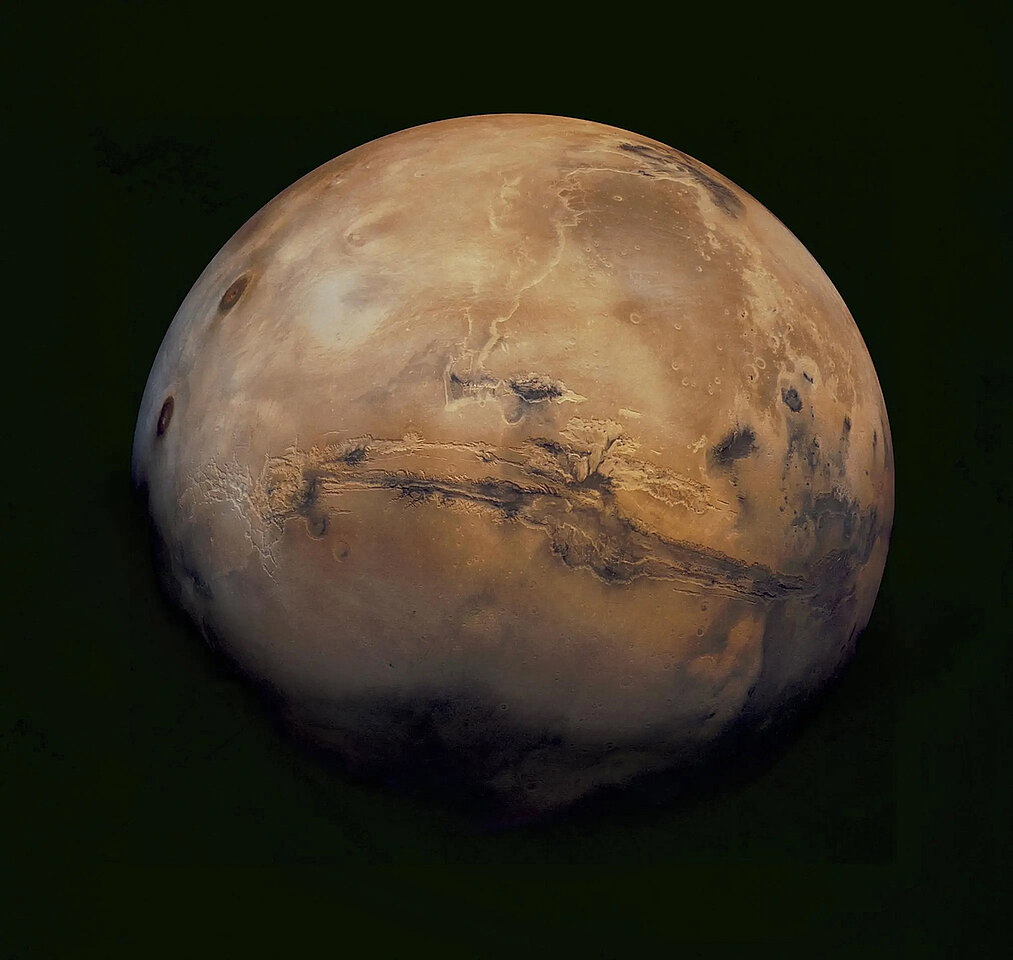
VaMEx develops autonomous robot swarms for future Mars exploration
Scientists investigating whether Mars once supported life are developing a new approach to planetary exploration. VaMEx, an initiative of the German Space Agency at DLR, is working on technologies for groups of robots that can communicate with one another and operate autonomously. The longer-term aim is to explore difficult Martian terrain with a coordinated team rather than relying on a single rover.
A team of robots instead of one explorer
The concept brings together flying, walking and wheeled robots. They would investigate the vast Valles Marineris canyon system and enter caves thought to exist in the region, including places that conventional exploration vehicles would struggle to reach. The machines would collect images and other measurement data.
Caves could provide important environments for studying whether Mars supported life in the past. The announcement does not report a discovery of life, however. Researchers are still developing the systems that could enable such investigations.
Moving without continuous commands from Earth
One-way communication delays between Earth and Mars can exceed 20 minutes. NASA explains that commands take 3–22 minutes to reach Perseverance, depending on the planets’ positions. Such delays make continuous human control difficult. Researchers therefore want the robots to establish their positions and coordinate their movements without waiting for instructions at every step.
The navigation system under development will combine information from star and sun sensors with positioning data from radio beacons. Mars has no satellite navigation network equivalent to GPS on Earth, making the combination of different measurements particularly important. This approach would provide a foundation for coordinated operations across challenging terrain.
SkyCAM tests planned in Portugal in 2027
The VaMEx initiative has been running since 2012 and has reached its fourth development phase. A camera system called SkyCAM is scheduled for testing under Mars-like conditions in Portugal in April 2027. According to the University of Würzburg’s announcement dated 11 November 2026, the AMADEE-27 analogue mission is planned for 5–18 April 2027 in Monsaraz. SkyCAM is being adapted for integration into the Janus rover.
The university’s new sub-project began in October 2026 and will run for three years. Teams led by Hakan Kayal and Guido Dietl are involved, with approximately €1.4 million in DLR funding. Sky-observation hardware and technologies supporting robot navigation are being developed within the same research effort.
No confirmed Mars deployment yet
A mission sending this robot swarm to Mars has not yet been confirmed. The announced work focuses on developing technologies that will be assessed through terrestrial analogue missions and field testing. If successful, such systems could allow future planetary exploration to use cooperating autonomous teams rather than individual robots.
Source: University of Würzburg, 11 November 2026. Communications context: NASA. Image: NASA / JPL-Caltech, via the university’s press announcement.


