




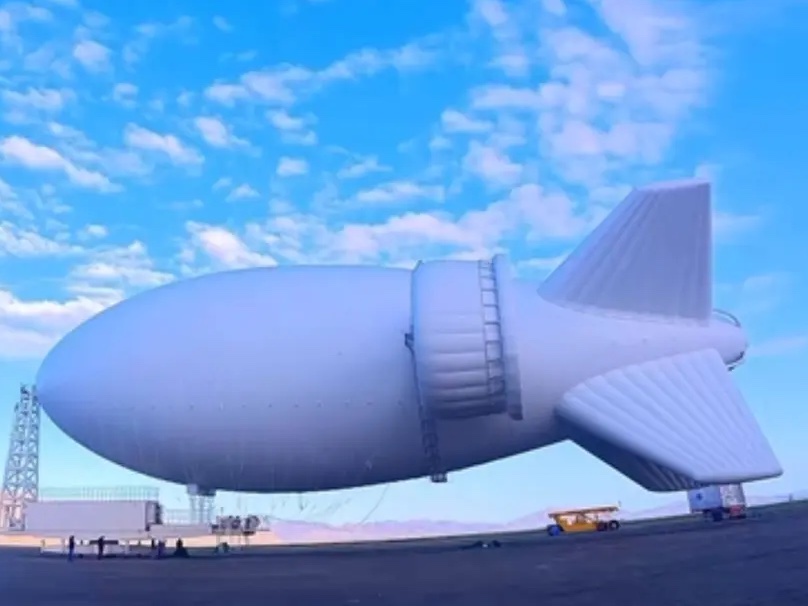
China’s S4000 airborne wind turbine tested in Yueyang
Clean Energy
Hits: 2
China’s S4000 airborne wind-energy system underwent a flight test near Yueyang on November 6, 2026. The helium-supported platform explores the use of high-altitude winds to generate electricity.
Wind turbines are usually mounted on tall towers. S4000 instead aims to lift them into the sky. Developed by Linyi Yunchuan, the platform is approximately 67 metres long, 40 metres wide and 23 metres high.
How does the electricity reach the ground?
Turbines on the platform turn in the wind and generate electricity. Power is transmitted down a special tether connecting the system to the ground. The connection also helps maintain the platform’s position.
What does the Yueyang test show?
S4000 previously underwent validation at an altitude of 4,000 metres at a test site in northwestern China, according to the report. That earlier test must not be confused with the November 6 Yueyang flight: it does not establish that the latest flight reached 4,000 metres.
A local reporter’s account dated November 7 describes the new flight in real conditions around Yueyang. Safety and stability are especially important when operating near a city.
More work is needed before commercial deployment
High-altitude winds can be stronger and more consistent, a potential advantage of the approach. The aim is to produce energy without the massive towers and foundations required by conventional turbines.
A test flight, however, is not proof of commercial maturity. Long-term durability, electricity costs, reliability in different weather conditions and safe operating requirements need further assessment. The source does not establish that large-scale commercial operation has begun.
Power generation could eventually extend from land and sea into the sky, but demonstrations still need to translate into sustained production performance.
Source: November 7, 2026 report on the S4000 Yueyang test.
Dji Banner Inside Article - 728x90



