




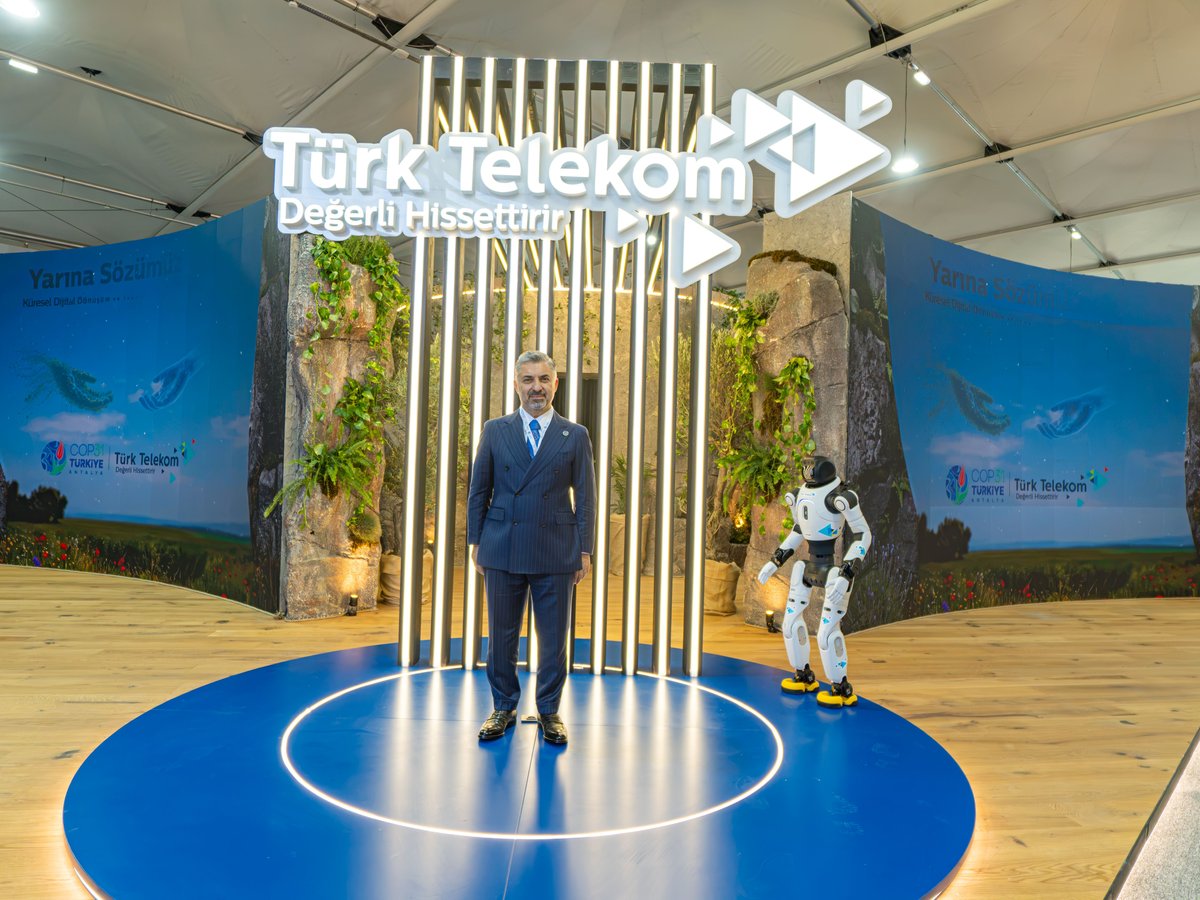
Türk Telekom sets out 400 Gbps COP31 network and 530 MWp solar target
Clean Energy
Hits: 3
Türk Telekom says it has built 400 Gbps connectivity capacity for COP31 and aims to reach 530 MWp of solar capacity across three plants. Its 8 November statement adds technical capacity and green-energy details to the previously announced summit partnership.
Dji Banner Inside Article - 728x90

The information, targets and assessments below are based on Türk Telekom’s press release dated 8 November 2026.
Leading Türkiye’s digital transformation with its commitment, “We Have a Promise to Tomorrow,” Türk Telekom is bringing its technology and sustainability vision to the world stage at COP31.
Türk Telekom technology shapes the future for a sustainable world
Türk Telekom, which leads Türkiye’s digital transformation and places sustainability at the centre of its business strategies, is shaping its technology investments around the goal of a more liveable future. In line with this vision, Türk Telekom is participating as Master Partner and supporter of “Global Digital Transformation and Technology” at COP31, which Türkiye will host for the first time in Antalya. Taking end-to-end responsibility for the summit’s entire technology infrastructure, the company is building a comprehensive digital infrastructure to meet all the communication needs of national and international participants, country delegations, members of the press and visitors. Establishing an integrated system at the summit venue that encompasses a data centre, a network operations centre and cybersecurity operations centres, Türk Telekom is preparing to connect COP31 to the world at fibre speed. It will shape the event’s digital environment with solutions offering high capacity and full coverage, including 5G technology.
Türk Telekom contributes to Türkiye’s green transformation through a holistic approach spanning renewable energy investments, energy efficiency, sustainable financing and domestic technology development. Having invested $24.5 billion since 2005 and maintained its position as the sector’s investment leader for the past five years, Türk Telekom regards its growth not only as a financial success but also as an important source of strength supporting its investments in Türkiye’s digital and green transformation. The company has also brought the total value of its issuances through sustainable financing instruments to $1.1 billion, and its work in this field has earned recognition from international organisations. A constituent of the BIST Sustainability 25 Index, Türk Telekom received the highest grade, A, in climate change for the second consecutive year in CDP’s 2025 assessment, while achieving A− in its first water security disclosure. Also recognised this year at CDP Türkiye’s Climate and Nature Conference for its performance in climate and water management, Türk Telekom continues to invest with the aim of leaving a more liveable world to future generations. Following the solar power plant it commissioned in Sivas, Türk Telekom aims to meet approximately 65% of its electricity consumption from solar power and reduce carbon emissions through the solar power plants it will commission in Malatya and Ağrı.
In remarks ahead of the 31st Conference of the Parties to the United Nations (UN) Framework Convention on Climate Change (COP31), to be held in Antalya from 9 to 20 November, Türk Telekom CEO Ebubekir Şahin highlighted digital transformation and green transformation as two complementary strategic areas. He said: “As we build Türkiye’s digital future, we are already planning which energy sources will power this infrastructure, how efficiently it will use resources and what impact it will have on the environment. We address digital transformation and green transformation together, transferring the experience we gain in our own infrastructure to solutions that improve resource efficiency across different sectors. We also see the responsibility we have assumed at COP31, which Türkiye is hosting for the first time, as an important part of this vision. As the world speaks in Antalya, the line carrying that conversation will be Türk Telekom’s. We will continue to contribute to sustainable development by turning the opportunities offered by technology into environmental and social benefits, and to help build a more liveable future on this journey we began with the commitment, ‘We Have a Promise to Tomorrow.’”
Placing sustainability at the centre of its business strategies with its commitment, “We Have a Promise to Tomorrow,” Türk Telekom shared its green transformation vision and the investments it has made in pursuit of that vision as part of COP31, where it is participating as Master Partner and supporter of “Global Digital Transformation and Technology.” Accelerating the energy transition through initiatives such as renewable energy investments, energy efficiency programmes and smart city projects, Türk Telekom supports these steps with sustainable financing sources.
In remarks ahead of the 31st Conference of the Parties to the United Nations (UN) Framework Convention on Climate Change (COP31), to be held in Antalya from 9 to 20 November, Türk Telekom CEO Ebubekir Şahin highlighted digital transformation and green transformation as two complementary strategic areas. He said: “At Türk Telekom, we see technology as a strategic force shaping Türkiye’s economic and social development. With a history spanning more than 185 years, our infrastructure and our engineering expertise, we now serve more than 58 million customers and cover nearly 35 million households with a fibre network extending over 592,000 kilometres. In developing infrastructure on this scale, we consider not only the connectivity we provide but also the resources we use and our environmental impact. Through our ‘We Have a Promise to Tomorrow’ approach, we address digital transformation and green transformation together, transferring the experience we gain in our own infrastructure to solutions that improve resource efficiency across different sectors. At Türk Telekom, we see technology not merely as a tool that meets today’s communication needs but as a strategic force shaping Türkiye’s economic and social development. As we build our country’s digital future with our strong infrastructure, technological expertise and engineering capabilities, we also place sustainability at the centre of our business strategy. From our renewable energy investments and energy efficiency programmes to domestic R&D projects and sustainable financing practices, we shape all our work around the goal of leaving a more liveable world to future generations. We also see the responsibility we have assumed at COP31, which Türkiye is hosting for the first time, as an important part of this vision. As the world speaks in Antalya, the line carrying that conversation will be Türk Telekom’s. We will continue to contribute to sustainable development by turning the opportunities offered by technology into environmental and social benefits.”
Türk Telekom powers COP31’s digital infrastructure
As COP31’s Master Partner and supporter of “Global Digital Transformation and Technology,” Türk Telekom has implemented the event’s digital infrastructure from end to end, creating a comprehensive technology infrastructure to meet the communication needs of international participants, country delegations and members of the press. Across the 1.1 million-square-metre summit venue, new fibre-optic connections have been installed along different routes to provide high-capacity, uninterrupted communications. This work has involved 1.3 million metres of fibre-optic cable to create a communications infrastructure that will connect the summit venue to the world at a capacity of 400 gigabits per second. An exchange with fibre connections fed from different directions has been brought into service, alongside redundant systems that allow capacity to be increased when necessary. A total of 1,800 wireless access points have been installed at the summit venue, while new base stations have been established to strengthen the mobile communications infrastructure, including 5G technology. With an integrated system incorporating a data centre, a network operations centre and cybersecurity operations centres also operational at the event, Türk Telekom aims to offer all participants a secure, high-capacity and uninterrupted communications experience throughout the summit. Demonstrating Türkiye’s technological capabilities on an international scale, this work also represents an important reflection of Türk Telekom’s vision of integrating digital infrastructure investments with its approach to sustainable development.
Digital transformation and green transformation move forward together
Türk Telekom considers the opportunities offered by digitalisation alongside the goals of energy efficiency, effective resource use and reduced environmental impact. Reducing energy consumption and using resources efficiently are among the priorities in developing next-generation communications infrastructure. In line with this approach, Türk Telekom is increasing its renewable energy investments while expanding the use of next-generation technologies that improve energy efficiency in its fixed and mobile networks. Through renewable energy investments, an important component of its sustainability strategy, Türk Telekom aims to meet a greater share of its energy needs from clean sources. The first phase of Türk Telekom’s solar power plants has been commissioned in Sivas. With new plants planned for Malatya and Ağrı, its renewable energy capacity will reach a total installed capacity of 530 MWp. In addition to its solar power investments, Türk Telekom is expanding the use of renewable energy at base stations and has increased the total installed capacity of rooftop solar installations at its base stations and fixed-site buildings. Improving the efficiency of its energy infrastructure through solar-and-grid hybrid solutions, a solar-powered trailer hybrid energy system and next-generation cooling technologies, Türk Telekom is also developing projects to harness geothermal resources in the Central Anatolia region.
Türk Telekom CEO Ebubekir Şahin explained the role of solar power investments in the company’s long-term energy strategy: “As we build Türkiye’s digital future, we attach as much importance to how efficiently our infrastructure uses energy and the sources from which we obtain that energy as we do to its connectivity capacity. While expanding technologies that improve energy efficiency in our network, we are growing our solar power investments to meet a greater share of the electricity we consume from renewable sources. We took the first step in Türk Telekom’s solar energy investment in Sivas. Our plant, which we commissioned at the end of 2025, meets approximately 15% of our electricity needs. Following Sivas, next in line is the plant we will establish in the Darende district of Malatya. This investment, which will be Türkiye’s third-largest solar power plant by installed capacity when it enters service, will be followed by our project in Ağrı. With our three plants, we aim to reach a total installed capacity of 530 MWp, meet approximately 65% of our current electricity consumption from solar power and reduce our carbon emissions. In doing so, we will take an important step towards meeting our network’s long-term energy needs from clean sources while also contributing to Türkiye’s green transformation. We also see the results of this approach in our sustainability performance. We are included in the BIST Sustainability 25 Index. In CDP’s 2025 assessment, we received the highest grade, A, in climate change for the second consecutive year. In our first water security disclosure, we achieved an A− grade. Our performance in climate and water management earned us an award this year at CDP Türkiye’s Climate and Nature Conference.”
Sustainable financing reaches $1.1 billion
Alongside its strong financial performance, Türk Telekom supports its green transformation goals through sustainable financing secured from international capital markets. Having issued a $500 million sustainability Eurobond in 2024 and a $600 million green Eurobond in 2025, Türk Telekom has brought the total value of its issuances through sustainable financing instruments to $1.1 billion. While using the proceeds to support its long-term investment goals, Türk Telekom addresses financial sustainability together with environmental responsibility. The company has also achieved significant results in its environmental performance. In 2025, Türk Telekom reduced its market-based Scope 1 and 2 emissions by 35% compared with the 2020 base year and continues to work towards its target of reaching net-zero emissions by 2050. Maintaining its A grade in the CDP 2025 Climate Change Programme, Türk Telekom received an A− in the Water Security Programme, in which it participated for the first time. Also a constituent of the BIST Sustainability 25 Index, Türk Telekom continues to improve its sustainability performance in line with international standards.
Sustainable urban transformation through digital technologies
Türk Telekom also uses the opportunities offered by digital technologies to make cities and production processes more efficient, secure and sustainable. Developing solutions that enable more effective resource use in energy, transport, the environment and public services through technologies such as 5G, artificial intelligence, the Internet of Things and data analytics, Türk Telekom contributes through its smart city applications to more efficient management of urban energy consumption and the optimisation of transport processes.
Source: Türk Telekom press release, 8 November 2026 (Faselis).


