23.11.2026 12:45















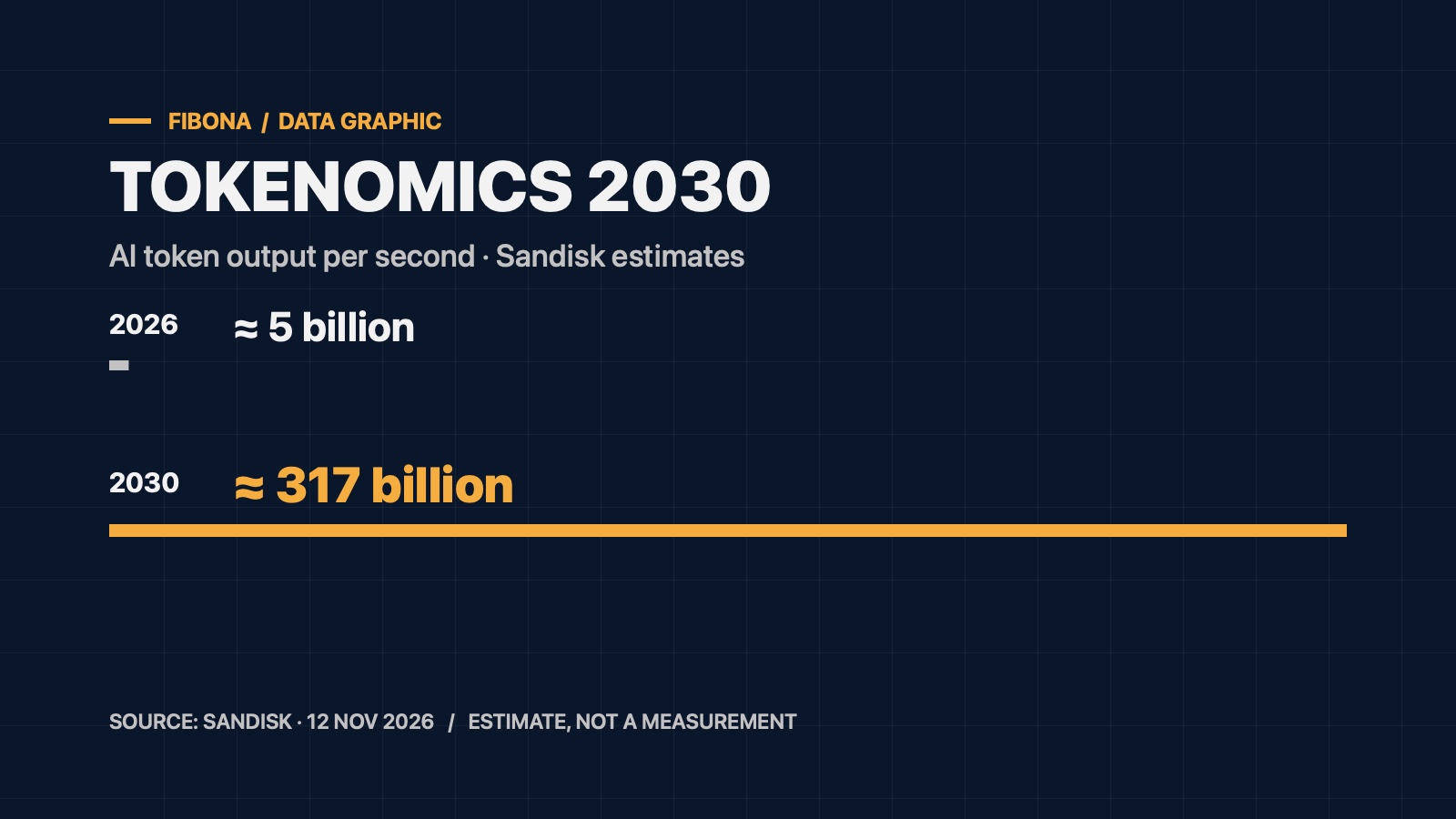
Sandisk’s Tokenomics 2030 outlook estimates that AI systems could generate about 317 billion tokens per second by 2030, compared with a 2026 baseline of roughly 5 billion per second. Sandisk published the outlook on November 12 and distributed a Turkish press briefing on November 23. These are company model estimates, not measured global output.
A token is a unit of data that an AI model processes or generates. For a language model, it can represent a word, part of a word or punctuation. Sandisk puts annual output at around 150 quadrillion tokens in its 2026 baseline and close to 10 quintillion in its 2030 scenario. Counting tokens helps describe how much work an AI system does, but does not measure how accurate or valuable the output is.
Sandisk considers the electricity available for inference, the number and performance of accelerators, memory bandwidth, networking and storage. The scenario also includes potential gains in hardware utilization and software efficiency. That means greater output can come from using existing infrastructure more efficiently as well as from building more data centers.
Storage needs depend on how a model reuses intermediate data, how long its context is, which model is running and where data is retained across the system. Two workloads that generate the same number of tokens therefore need not require the same storage capacity. Sandisk supplies flash memory and storage itself, and the outlook reflects an infrastructure vendor’s perspective.
Sources: Sandisk’s Tokenomics 2030 announcement and its full outlook. Graphic: Fibona, using Sandisk’s estimates.
