




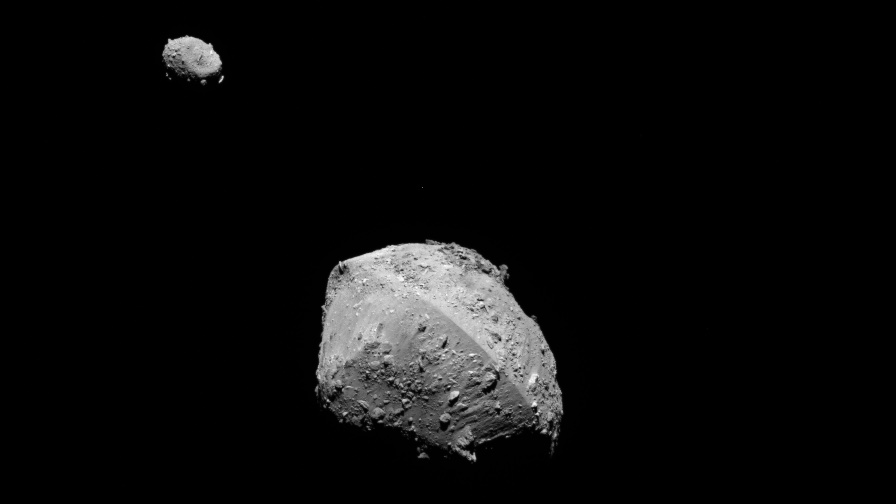
Hera photographs the crater DART left on Dimorphos
Automation
Hits: 16
The European Space Agency’s Hera spacecraft has photographed Dimorphos, the asteroid moon NASA struck four years ago in a planetary defence test. Observations released by ESA on 25 November point to a flattened impact face with a crater about the size of a sports stadium.
The orbit changed. What happened to the surface?
NASA’s DART spacecraft deliberately struck Dimorphos on 26 September 2022. Telescopes on Earth measured a reduction of about 33 minutes in the moonlet’s orbital period around Didymos. Those observations could not show whether the collision dug a crater, reshaped the whole moonlet, or both.
Dimorphos is about 151 metres across; that is the moonlet’s diameter, not a measurement of the crater. The larger Didymos measures about 730 metres across. In Hera’s 7 November photograph, taken from roughly 29 kilometres away, Dimorphos is at upper left and Didymos is near the centre. ESA reports a clear change on the struck face, while boulder fields elsewhere still resemble those seen in 2022.
Hera will deploy two small spacecraft
Repeated observations show Dimorphos tumbling irregularly as it orbits Didymos. Hera also detected hundreds of metre-scale rocks orbiting the pair. ESA says it will account for them as the spacecraft approaches for higher-resolution imaging in December. The team plans to deploy two small spacecraft, Milani and Juventas, in January 2027.
Photograph: © ESA (AFC instrument). Sources: ESA, Hera mission gallery and NASA DART.









