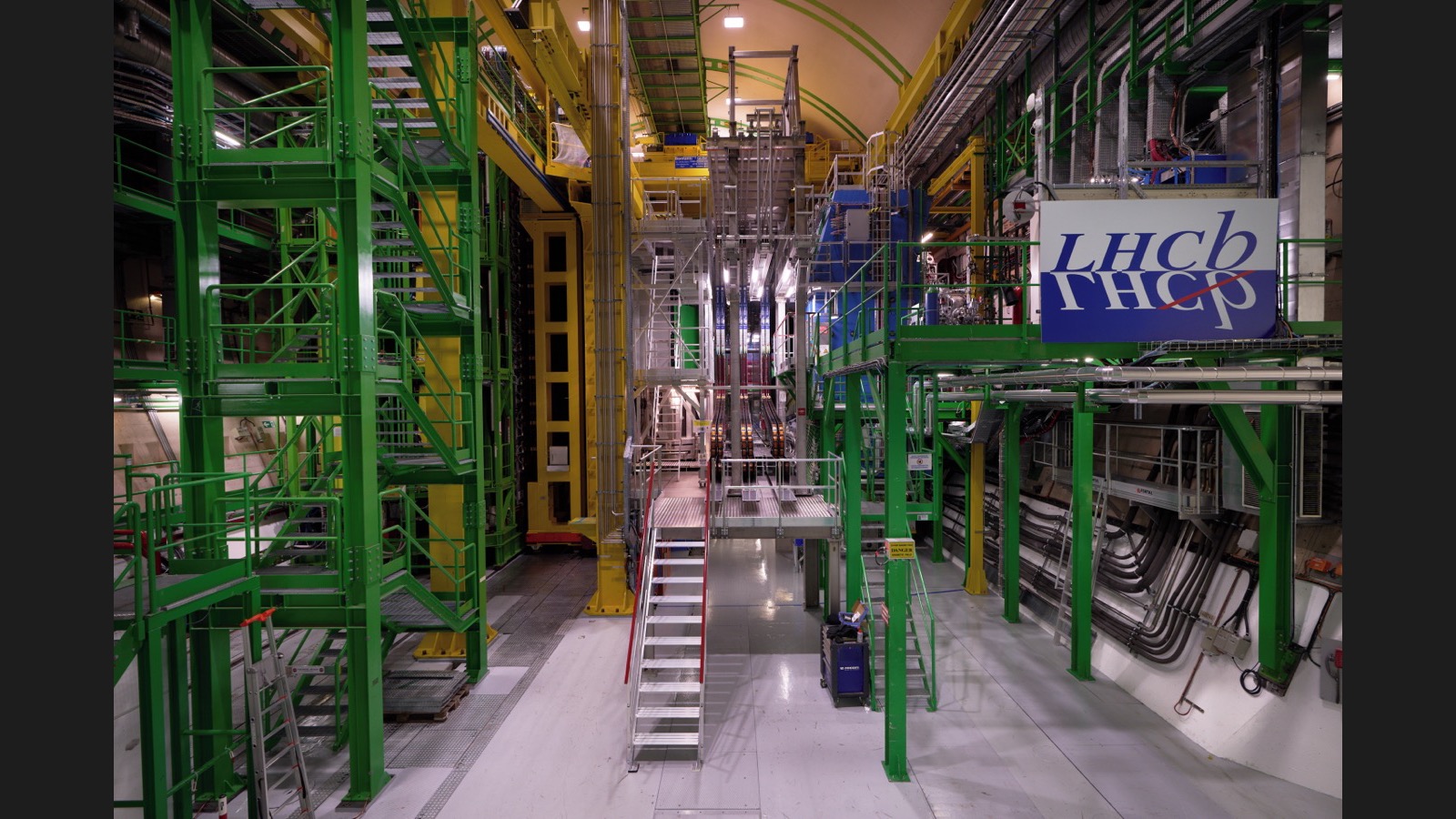
The LHCb experiment at CERN has found new evidence for a particle transformation expected to occur roughly once in ten billion decays. The study of a B⁰ meson turning into two muons is the first to reach this evidence threshold using data from a single experiment. It is not yet a discovery, and the measurements agree with the Standard Model.
Dji Banner Inside Article - 728x90
A rare event with a larger question behind it
Announced by the LHCb Collaboration on 3 November 2026, the result concerns a meson containing a beauty quark and a down antiquark, known as B⁰ or Bd, decaying into two oppositely charged muons. A muon resembles an electron but is heavier. The extremely low probability of this transformation makes it particularly valuable to researchers.
In quantum physics, a particle’s decay is influenced by other particles. Unknown particles too heavy to be produced directly in collisions at the Large Hadron Collider could still alter the probability of this process. Scientists therefore look not only for new particles themselves, but also for unexpected behaviour in familiar ones. In general, the rarer a decay, the more sensitive it can be to certain effects of new physics.
3.2 sigma means evidence, not yet discovery
Data collected in 2024 and 2025 produced a statistical significance of 3.0 standard deviations, or 3 sigma, for the B⁰ decay into two muons. Combining that sample with data recorded between 2011 and 2018 raised the significance to 3.2 sigma. In particle physics, 3 sigma is the threshold commonly used to claim evidence. CERN explains this level as corresponding to about a 0.3% probability of a random fluctuation producing the signal.
The widely accepted discovery threshold is higher: 5 sigma. Future measurements will seek to reach that level. If confirmed, this would become the rarest beauty-particle decay ever observed. The present result does not mean that a new particle has been discovered or that the Standard Model has been disproved.
Why the earlier hint was not enough
A joint LHCb and CMS analysis published in 2015 first observed the decay of another beauty meson, Bs, into two muons, and also reported evidence for B⁰. Subsequent updates using data collected up to 2018 did not confirm the B⁰ evidence. The new study therefore provides a fresh test using one experiment, rather than simply repeating an established observation.
The Bs decay occurs around three times in every billion decays, while the predicted B⁰ rate is about thirty times lower. LHCb’s technical explanation notes that B⁰ production is approximately four times more abundant than Bs production, leaving a difference of roughly a factor of seven in event yields. Even so, separating the genuine signal from the many other muon pairs requires a particularly precise analysis.
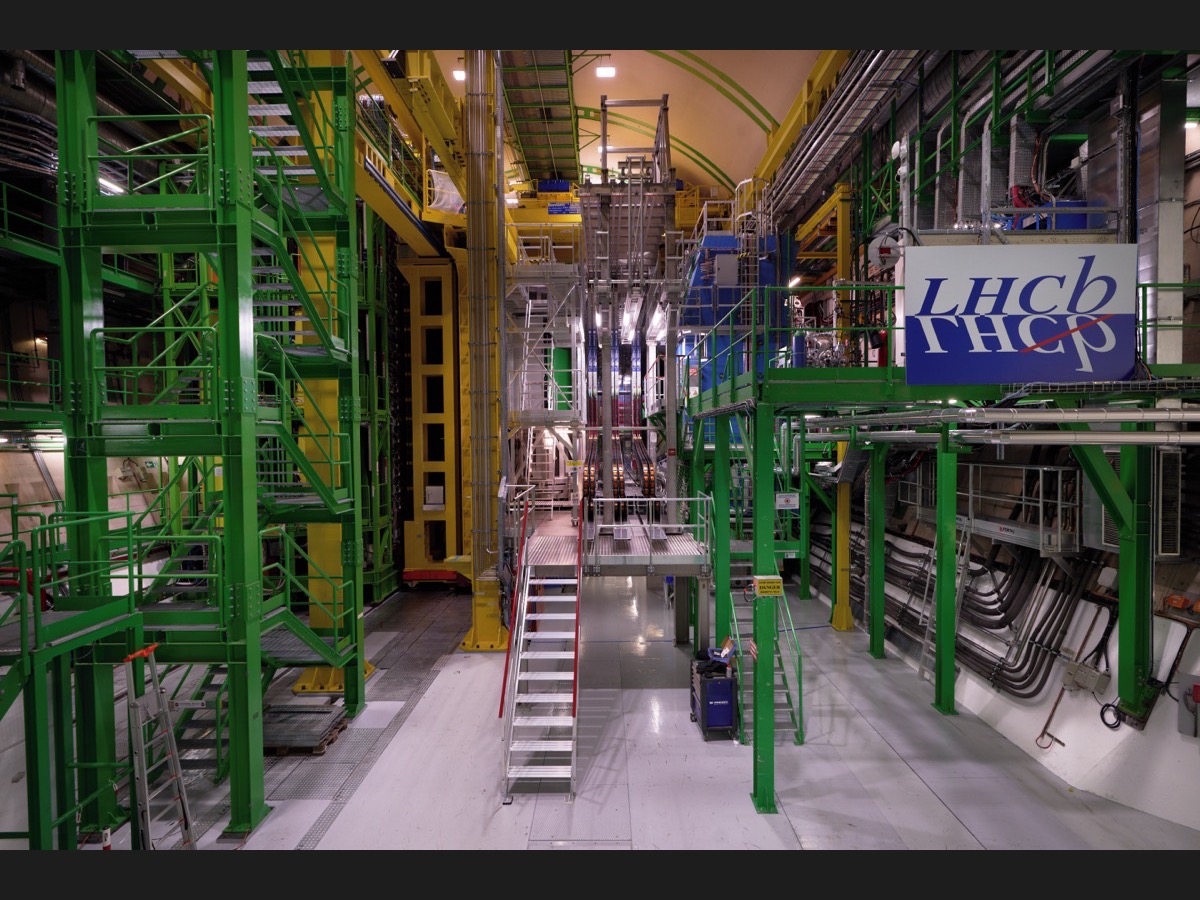
The LHCb experiment. Image: CERN.
Detector upgrades and machine learning
According to CERN, a major upgrade enabled LHCb to collect data in 2024 at five times the rate achieved between 2010 and 2018. The detector also became better at distinguishing different particle types. Combining these improvements with machine-learning techniques helped the team suppress background processes that would otherwise overwhelm the rare signals.
Marco Santimaria, co-leader of the 19-person international analysis team, emphasises that physicists have pursued this decay for more than forty years. The challenge is to identify the desired muon pairs among a much larger number of other events. Machine learning is not making a discovery by itself here: it is one of the analytical tools used to classify measurements and reduce background.
Complementary measurements from the same analysis
The team also made the most precise measurements yet of the branching fraction and effective lifetime of the previously observed Bs → μ⁺μ⁻ decay. Combining Run 1, Run 2 and Run 3 data gave an effective lifetime of 1.60 ± 0.16 ± 0.01 picoseconds, again consistent with the Standard Model.
Decay probability and effective lifetime are not interchangeable measurements. Some theories of new physics can change time-dependent observables without substantially changing the branching fraction. Models involving hypothetical additional Higgs bosons, Z′ vector bosons or leptoquarks can therefore be tested in more than one way. Agreement with the Standard Model remains scientifically useful: it narrows the conditions under which alternative models can still work.
The next step is more data
The planned start of the High-Luminosity LHC in 2030, followed by a further LHCb upgrade in the middle of that decade, could increase the data collection rate by another order of magnitude. More examples of these rare decays would strengthen both the attempt to reach 5 sigma and the sensitivity to undiscovered particles.
Harry Cliff, LHCb’s Rare Decays Convener and analysis co-leader, says the evidence opens opportunities to probe beyond the LHC’s direct reach. The result is a carefully measured step in a long experimental search: not yet a discovery, but an important indication of which questions deserve more precise measurements next.
Sam Altman’s Stanford talk is circulating again...
About Us
Praesentium eum architecto. Qui cumque quo autem enim et neque sed. Repudiandae dolorem dolor aliquam itaque placeat quia sunt odit ut. Perferendis libero optio reiciendis facilis ut minima. Quia voluptas molestiae. Vero voluptates et sunt qui animi dignissimos dolorem et quis.